New Year. New Updates!
Starting 2026 with lots of cool stuff on the horizon...

One of the frustrating things about this business is that you often receive such amazing news, but can’t share it with anyone until much later. So that means much of the time there are things I’d love to include in this newsletter that I have to stay silent about.
I’m pretty good at keeping secrets, and understand why it’s necessary to delay some good news, but that doesn’t make it any less frustrating. At any rate, be assured that some pretty cool stuff is on the horizon. For the time being, the news I can share at this time follows.
UPCOMING APPEARANCE
The date and location have been set for the official launch of my novelette, Shoeshine Boy & Cigarette Girl.
The event will take place at Bakka-Phoenix Books on February 7, at 2 p.m. Here’s the official event page where you can rsvp and reserve your book for signing.
In the meantime, a reminder that you can pre-order this book in both print and digital from several retailers by clicking the button below.
One of the people looking forward to this book is reviewer Jamedi of JamReads, who recently included Shoeshine Boy & Cigarette Girl on this list of 2026 releases he’s excited about.
HOW (AND WHY) I GATHER MY STATS
Before I get into the latest and forthcoming publications, I’d like to take a moment to share something a little different. This idea comes from Lisa Hislop who commented on my December roundup post and asked how I track everything I share at the end of the year.
I’m naturally a very organized person. I mean, I can be messy, but I tend to know where everything in that mess is—a skill that’s super helpful when writing long-form fiction.
When it comes to tracking all things writing-related, I first have to give a shout-out to The Submission Grinder, a tool that’s become invaluable to me (and many other writers). I even have a Submission Grinder t-shirt! Seriously big fan.
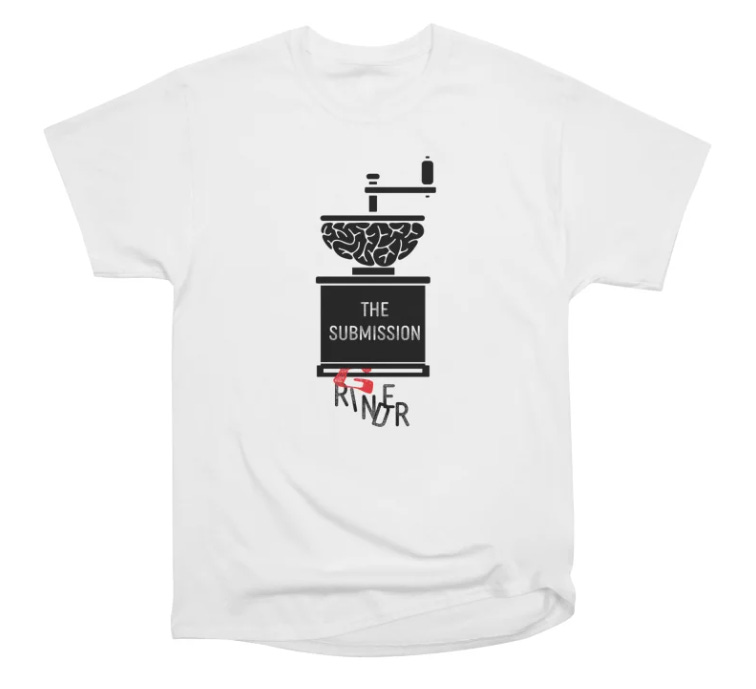
If you haven’t used it, in addition to helping writers find markets for their work, The Grinder helps us log submissions, and whatever comes after those submissions, be they rejections or acceptances. It also allows us to add things like payments, notes, and more. A handy dandy “dashboard” section lets us check stats by story or year. Because I’m diligent about filling in all the information, mine’s always up-to-date. This is a great way to see your progress at a glance.
Another tool I use is my own website, which I’m also diligent about updating. I don’t have to rely on memory for what I published, where, and when—I can just go there to find it all conveniently categorized and linked. The aim is to make it easy for readers to find my work, but it also helps me in the process.
In addition to these, I use Microsoft Excel to track multiple other things. I have a file with markets and relevant information for submissions, organized in order of priority based on the criteria that matters most to me. I have another one tracking my submissions and everything that comes after acceptance, for every story I write. This works as a companion to The Submission Grinder that I don’t need to be online to check. It’s also a backup should The Grinder website go down.
I also track any awards, accolades, reviews, etc. that a story might garner. It might surprise you, but after the initial thrill of such things, it’s easy to forget they even happened when you get busy writing something new, or the next story gets published, so I like to have it all in a place where I can easily find it.
In addition to all that, I keep a handwritten journal that I fill out whenever I do anything writing-related, which then goes into a digital document showing what I’ve accomplished month-to-month. This basically serves as an outline for this newsletter, and also as physical proof to myself that even when I don’t write every day, I’m making progress.
I also enjoy tracking my own personal stats. I have files that analyse each story I’ve written, tracking things like character names (and various traits), POVs, story lengths, how long they take to sell, and more. Do I need to track this? No. But it’s become immensely helpful in understanding my own voice, and recently became a useful tool when planning my lecture for Odyssey.
In terms of the contests I participate in as part of the Codex writers group, there’s usually a post-contest roundup I share with the other participants that includes things like the prompt that inspired the story, what it scored, and anything else about it—which I can later refer to for things like “The Story Behind the Story.”
Finally, I track things like personal goals I might meet throughout the year, and things like interviews or things I’ve been invited to participate in, that I also include in my end-of-year recap.
Now, when Lisa suggested this topic, she also said “you make celebrating yourself look easy.” The point of these roundups is not so much to celebrate myself and my accomplishments, though I do believe it’s important to do your best to celebrate accomplishments (big or small) that stem from our hard work. I share these things in part to keep readers informed, but also to encourage other writers to keep going, and to count all their accomplishments, even if they don’t necessarily share them with the world.
That all said, if I’m truly honest, what all these various tracking systems amount to is a really elaborate, and often time-consuming, mental health strategy I’ve developed over the years. I’ve mentioned before that I live with depression and anxiety. I say “live with” not “suffer from” precisely because I’m high-functioning and much of that is due to the methods I’ve devised for keeping my mental illness in check.
The primary way they affect my day-to-day writing life is in a lack of motivation, and of course, imposter syndrome. So all these things I track are tangible proof that I’m getting somewhere, which helps with motivation. When I’m feeling like I haven’t done enough, I can see that I’m wrong. If I’m feeling like none of it matters because no one likes my stories anyway, I can look at nice things people have said about them, positive reviews, and more. These recaps are as much for me as they are for readers.
In his blog, actor Wil Wheaton likes to say “depression lies.” It does. Thing is, you can know that rationally and still be fooled by your own brain. Tracking all these things isn’t me bragging or stroking my own ego, it’s a survival strategy. One I choose to share at the end of each year. I don’t share every little thing. Some things are private. I also don’t share all the negative things because the goal for me is not to dwell on those. But that’s why I always begin with the disclaimer that these are the highlights only. The last thing I want is for someone to feel like they’re not good enough because they’re comparing themselves to my highlight reel.
So there you have it. I hope this answers your question, Lisa, and I hope it shines a light on how—and why—I do these yearly recaps, and also part of the reason behind these monthly updates.
If you’re like Lisa, and have other topics you’d like to see covered in my newsletter, feel free to comment and let me know.
RECENT PUBLICATIONS
“The Space between Us” was published last month in Lightspeed’s December issue, and on Christmas Day became free-to-read online.
This story is about a couple from two different worlds (literally) trying to make their relationship work. If you missed it, you can read it here.
Also, on New Year’s Eve, the Worlds of Possibility Volume 2 anthology came out. This one reprints my story, “Feathers,” published this past June. The entire anthology (with all 85 stories) can be downloaded for free here. Get yours today!
FORTHCOMING PUBLICATIONS
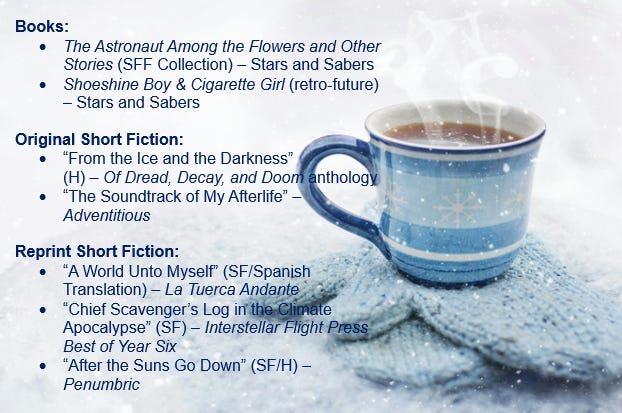
My very next publication comes in just a few days on January 10 when the Spanish translation of “A World Unto Myself” comes out in the Argentinian zine, La Tuerca Andante. Translated by Argentinian author, Cezary Novek, the story’s Spanish title is “Un mundo en mí mismo.”
I’m really excited for this translation because much of my family are native Spanish-speakers, so it’ll be a lot easier for them to read this story than my English publications have been. So I’m looking forward to seeing this one out in the world.
Some of you might recall that I was thrilled to sell Shoeshine Boy & Cigarette Girl last year in part because novelettes are notoriously tough to sell. Well, it seems I’m on a roll, because my other novelette, “The Soundtrack of My Afterlife,” was accepted just this past month by Adventitious.
This story will be appearing in their inaugural issue on February 1, just two days before the publication of Shoeshine Boy & Cigarette Girl. So I have a lot to look forward to next month.
“The Soundtrack of My Afterlife” is a fantasy story about the bond between a girl and her car, and the music that shaped them both. I hope you’ll subscribe to Adventitious to support this new market and enjoy all the great fiction to come from them. As a special treat, I’ve compiled a playlist of music inspired by this story. That’ll go out to my newsletter subscribers when the story’s out. Subscribe today so you don’t miss out!
OTHER THINGS I’VE BEEN UP TO
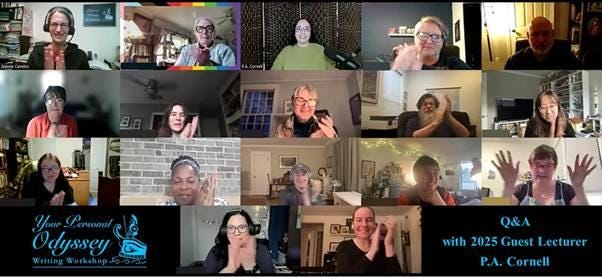
If you missed it, the Odyssey Workshop recently shared an excerpt from the Q&A period that followed the lecture I did for them back in November. The students asked some great questions that day. You can read my responses to a couple of them here.
FUN STUFF
As you might recall from previous years, I have a tradition of taking all the year’s cover art from books and magazines that published my work and making mini versions of them that I then put in a Christmas ornament that I hang on my tree. The tradition continued this year with some more great covers.


I also recently received both the print copy of Shoeshine Boy & Cigarette Girl and my contributor copy of Year’s Best Canadian Fantasy & Science Fiction, Vol. 3, which officially completed the shelf I have for my own published work.
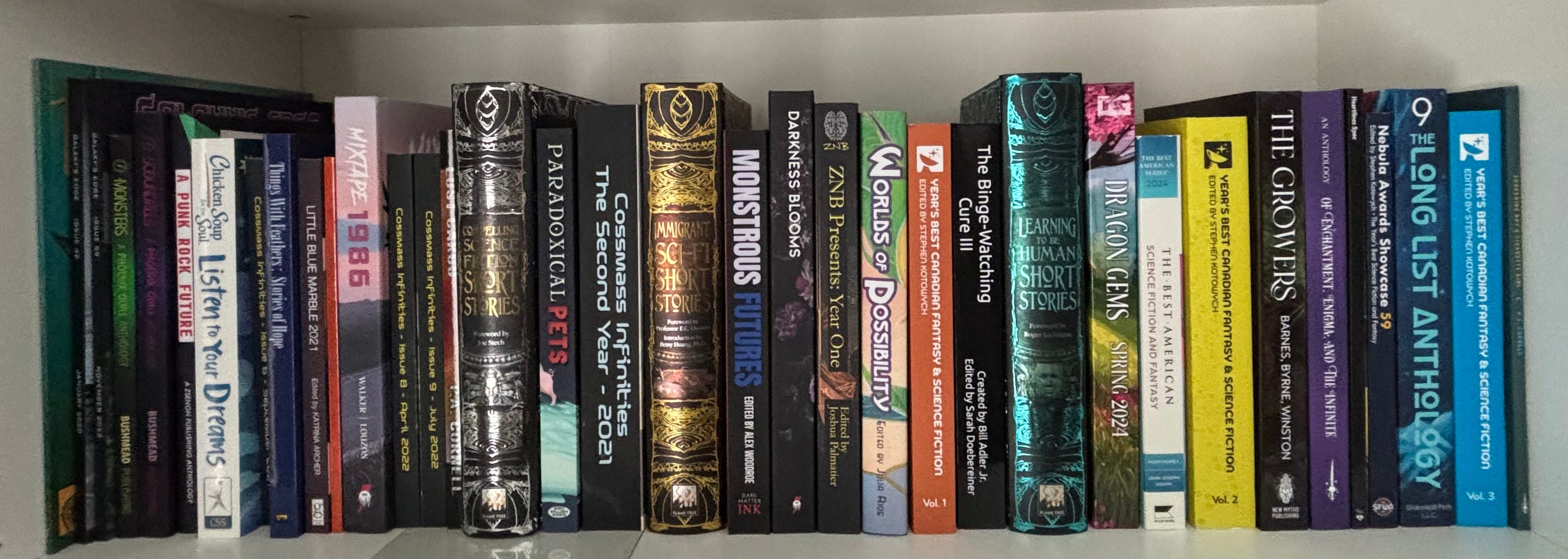
Now to start a new shelf!
FOR YOUR AWARDS CONSIDERATION
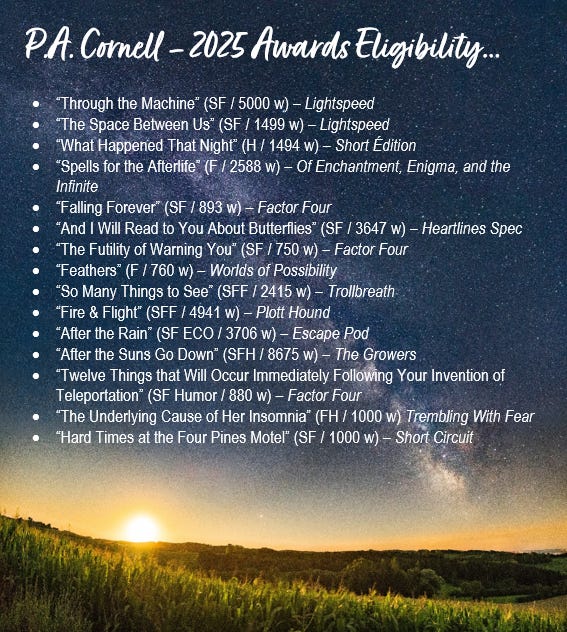
If you’re reading for awards and only have time to read one of my stories, the one I’d most like people to consider is, “Through the Machine,” which came out May of last year in Lightspeed magazine and was featured by Gizmodo.
Here’s what the good folks at Gizmodo had to say about it:
“A movie star endures Hollywood’s dystopian embrace of AI in this near-future short story. ‘Through the Machine’ by P.A. Cornell evokes a ‘Black Mirror’ show-biz nightmare come to life.” - Gizmodo
For those with lots of time to read, you can find my full 2025 eligibility post here.
Thank you for keeping my work in mind when nominating and voting.
THE STORY BEHIND THE STORY: “Twelve Things that Will Occur Immediately Following Your Invention of Teleportation”
Just recently my husband and I were talking about the fact that I don’t just write one kind of story. Readers of my work tend to either gravitate toward certain kinds of my stories, or else have as broad a taste for fiction as I do. Some of my work can be quite dark. Some of it gets you right in the feels. While other stories are light, and silly, and just aim to put a smile on your face (and mine). “Twelve Things”—as I call it for short—is an example of the latter.
Technology can be great. I’ve seen a lot of innovation over my lifetime and have witnessed changes that have made vast improvements in how we live our lives. Case in point: being able to listen to the song you want, when you want it, without having to rewind or fast forward. Seriously guys, that used to drive me nuts as a kid. If you skipped that part of history, consider yourself fortunate.
That said, tech isn’t always perfect, especially in those early days after it’s introduced and we’re treated to the joys of bugs no one expected. That’s why now and then I’ll write a silly little piece about tech gone wrong. Stories like “8 Laws I Wound Up Breaking While Attempting to Restore the Timeline” and “Hard Times at the Four Pines Motel.”
Many of my other stories are about tech gone wrong in one way or another too, but these tend to be on the darker or more serious side.
Often, my sillier stories will get their start during one of Codex’s flash fiction contests, so they tend to be on the shorter side. This is what happened with “Twelve Things,” which I wrote during the 2024 Flash Savior of the Universe contest. The prompt was simply to write a story in a non-traditional format. I’d done something similar the previous year with “8 Laws” so I figured I’d do a sequel of sorts with another list story. While “8 Laws” was about time travel mishaps, “Twelve Things” became about the problems with teleportation—and of course, cats.
Now, I’m a cat person. Don’t get me wrong, dogs are fine and I’ve written a dog story or two in my day. But I’ve had cats my whole life, and we just mesh better. I get cats. They get me. That all said, cats have…let’s just say, challenging personalities, at times. Or as I call it, cattitude.
They seem to delight in engaging in play that humans find less enjoyable. Often things we very much do not consider toys, become playthings in a cat’s paws. At times these are things that could even be dangerous for the cat to play with—or worse, mistake for food.
Fun Fact: At the time of this writing all our Christmas ornaments are out and I spend much of my day trying my best to keep my two cats, Jax and Rebel, from destroying and/or eating them.
Cats are also clever, and fast, and all it takes is a momentary distraction to find yourself chasing your furry friend around the house while they laugh at you (Internally. Cats can’t physically laugh) and win this latest game of keepaway.
So I came up with this story about a guy who succeeds in creating a teleporter—an invention that if accessible to enough people, would forever change our world (See also “Hard Times at the Four Pines Motel”). Not only does he find a way to make teleportation work, but he also manages to miniaturize the technology. Good on him!
Thing is, writers—much like cats—can make your life interesting in all kinds of ways, and usually at the worst possible time. At least if you happen to be a fictional character.
My main character in this story kind of gets ahead of himself after cracking this invention. He’s already envisioning winning the Nobel, after all. If you think about it, his cat Quark is doing him a favor by ingesting the WTID and in so doing, teaching him a little humility.
Fun Fact: When writing this story I couldn’t immediately think of a good name for the device so I left it to be filled in later. Then I found I kind of liked the idea of it having a name that doesn’t exactly roll off the tongue, and that its inventor knows needs to be changed to something better, so I left it as a name still being workshopped.
In the end, things work out for my poor, hapless inventor, but not before he’s had one hell of a day. Anyone who’s ever lived with a cat, can probably relate on some level. And somehow, we still love them. (I mean, the ancient Egyptians revered them as gods!)
This story fared quite well during the Codex contest that year, coming in second place for my division the week I wrote it, and scoring pretty decently as well. I didn’t immediately send it out on submission, but when I did, it sold very quickly to Factor Four, making it the second story of four that I’ve sold to this market to date.
I really appreciate the variety of stories they publish in Factor Four. There’s something for every kind of reader there, and they offer writers fair contracts, so I’m happy to keep sending them my work.
Following its publication, Myna Chang included this story in her April 2025 Flash Fiction Roundup, saying, “This is a delightful story! I smiled the whole time I was reading it, and appreciated the little burst of happiness.” Exactly what I’d hoped reader reaction would be when I wrote it.
I hope it’s put a smile on your face too.
“Twelve Things that Will Occur Immediately Following Your Invention of Teleportation” was originally published in April 2025 in Factor Four.
Thanks for joining me for another year of monthly updates. Likes and shares are always appreciated, and if you haven’t yet done so, click the link to subscribe.
P.A. Cornell
Thank you so much for your answer to my questions! And especially sharing about how this celebration of your work helps you manage your mental health. I struggle with similar feelings (as do MANY of my writers), and I know we will all squirrel away pieces of what you do to use for ourselves.
I already keep a "good things" file for my good reviews, but in thinking through the redundancies built into your process, I realize I don't track as thoroughly when I'm not feeling as positive about myself. You've inspired me to use my tracking (and celebrating) intentionally as self-care. Thank you 😊